
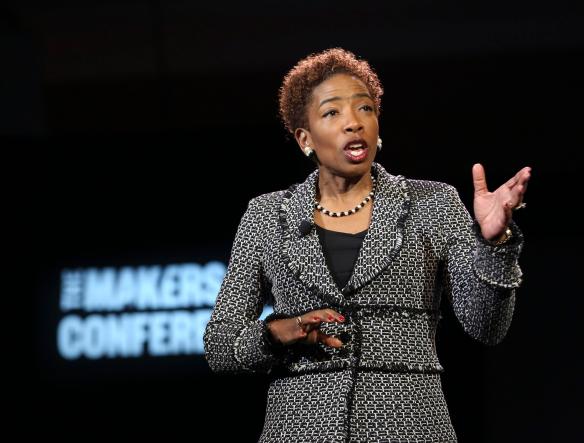
Credit Line: Image © Getty Images/ Jonathan Leibson used under editorial license.
I’m currently reading The Wealth Choice by Dennis Kimbro, a book that introduces readers to several extraordinary entrepreneurs. Each story is compelling in its own right, but one woman in particular stood out to me: Carla A. Harris. She is the epitome of resilience—someone who, when told she couldn’t, made it her mission to prove that she absolutely could. Before diving into her achievements, it’s important to understand the foundation that shaped her remarkable journey.
Carla A. Harris was born in Port Arthur, Texas, on October 28, 1962. She later moved to Jacksonville, Florida, where she attended and graduated from Bishop Kenny High School. Throughout her upbringing, her parents instilled in her an unwavering expectation of excellence. Despite this, Harris had never considered applying to Ivy League schools until she overheard classmates discussing their own applications.
Inspired, she approached her guidance counselor for advice, only to be told she shouldn’t apply. The counselor insisted the schools would be too difficult for her to get into and encouraged her to focus on colleges within Florida. True to her self‑described nature of being “negatively motivated,” Harris applied to every Ivy League school on her list—and was accepted by all of them. She ultimately chose Harvard University.
Coming from a modest background, Harris knew her family couldn’t afford the full cost of her education, and scholarships didn’t cover everything. Determined to succeed, she worked multiple jobs to make her Harvard education possible. Yet even at Harvard, she encountered detractors. She often recounts how her basic economics professor told her, “You can’t learn, girl.” Once again, she proved the doubters wrong, graduating Magna Cum Laude with an A.B. in economics in 1987, later earning an M.A. in business administration.
After her sophomore year, a summer internship on Wall Street sparked her interest in investment banking. Upon graduating, she joined Morgan Stanley in Mergers and Acquisitions and steadily rose through the ranks to become Managing Director in Global Capital Markets. During her tenure, she executed major IPOs, including UPS, Martha Stewart Living Omnimedia, and Immunex Corporation.
Her accomplishments have earned her recognition on some of the most prestigious lists in business. Fortune named her one of the 50 Most Powerful Black Executives in Corporate America (2009) and included her on their Most Influential list (2010). American Banker recognized her as one of the Top 25 Most Powerful Women in Finance (2011). Black Enterprise named her among the Top 75 Most Powerful Women in Business (2017) and one of the Top 75 African Americans on Wall Street for six consecutive years. Essence also honored her as one of the 50 Women Who Are Shaping the World. It’s no surprise she is often referred to as the woman who conquered Wall Street.
To date, Harris has authored five books and is a renowned global keynote speaker, sharing her insights in countries such as Finland, Ireland, and Sweden. In 2013, President Obama appointed her to chair the National Women’s Business Council. Beyond her corporate achievements, she is also a celebrated gospel singer and a passionate advocate for inclusive leadership.
In her speaking engagements, Harris emphasizes the power of authenticity, explaining that being true to oneself builds trust and reveals unique competitive advantages. She also underscores the importance of taking risks, arguing that avoiding risk limits your potential because you never discover how far you can truly go. She encourages audiences not to fear failure, reminding them that failure brings lessons, experience, and growth. As she often says, “Fear has no place in your success equation.”
Perhaps one of her most powerful messages is the importance of owning your power. She warns against allowing others to define your capabilities, as doing so hands your power over to them. The only time you should give away your power, she says, is when you use it to “empower others to grow your impact.”
Carla A. Harris’s journey reminds us that wealth creation is not solely about financial capital—it is also about influence, visibility, and the ability to open doors for others.
 Entrepreneurs and Wealth Creators of Color